
Hardscape Frequently Asked Questions (FAQs)
At Bristoll Plantation, we believe informed homeowners make better decisions. This FAQ page is based on real-world experience designing and installing patios, pavers, pool decks, and landscapes throughout Elkton, Maryland and the surrounding Mid-Atlantic region. Our goal is to clearly explain common hardscape and landscaping questions so you understand how projects are properly built, what materials are used, and what to expect before construction begins.
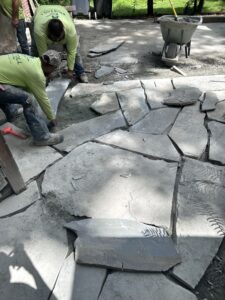
What is a typical patio base?
A typical patio base is crushed stone. When putting in a patio base, you need to excavate 10” minimum fallowed by a patio underlayment and 5” to 6” compacted crushed stone base. After compaction the crushed stone is covered with a sand setting bed that gets leveled. This bed is then followed by the pavers and the pavers are then grouted with “Polly Sand’.
What is “Polly Sand”?
Polly Sand is a grout that goes between the pavers in the joints and it hardens like cement but is pliable enough to expand and contract as the temperature changes.
What is a “Geo-Textile?
Geo-Textile is an underlayment that goes down after excavating for paver construction. It goes on the ground and the base material goes on top of it. It’s purpose is to provide stabilization and prevents the pavers above it from shifting.
What is the most popular paver you install?
The most popular paver we install is a 3 piece pattern paver. There are three different sizes and they make what is called a “French Pattern”. Several paver manufactures make a three piece pattern paver system.
How much mulch should I get in my landscape beds?
There should be 2” to 3” of mulch in your beds. This is enough to keep sun light from getting to the soil which causes weeds to grow and it is thick enough to keep sun light from wicking moisture out of the soil quickly. Any thicker and the mulch can get a crust on it and the crust will actually keep rain water from soaking in. The crust causes rain water to sheet and runoff.
What is a native plant?
A native plant is one that is indigenous to our Mid-Atlantic region. It is also the definition of a low maintenance plant. Because it is indigenous to our climate it makes it well adapted to hot dry summers and long cold winters as well as our soil types. All of that makes it easy and less expensive and time consuming to maintain.
What is a sitting wall?
A sitting wall is an 18” height double sided wall with a cap. It usually boarders the perimeter of a back yard patio. It doe provide seating and it acts as an architectural feature to define the patio space.
What is the average size patio?
The average size patio is between 350 and 450 square feet. This is because that is usually how much space is need to dine and socialize in a typical get together. There is room for a table, the grill and even a fire pit. Many patios are larger or smaller depending on client needs and wants.
What is the typical size paver pool deck?
Typically paver pool decks surround a pool and most of them are large because they need to encompass the pool. They range from 1,200 to 2,400 square feet and need to bump out for sun bathing and entertaining, and might even run up to and under a pavilion or pool house.
What is the typical rise of a hardscape step?
Most hardscape steps have a 6” rise because the stone used to build steps is sold in 6” height increments. Most wood steps are 7” and most code requirement specify step rises can not exceed 7-3/4” there for an 8” step is not permitted by code.
When you build a patio or walkway with pavers is it level?
No, the surface looks level but it has a typical 1” pitch in 4’. This is to allow water to run off and away from the house or structure the patio or walkway is leading to.
What can I use as an edging so mulch doesn’t dribble onto my pavers?
An edge stone boarder is most frequently used to solve this problem. An edge stone looks like a paver but it is specifically made to stand up-right 4’ above the paver surface and keep mulch from getting all over your pavers.
What is the typical width of a paver walkway?
Typically a paver walkway is 4’ wide. This is standard so two adults can pas without having to step into the grass or mulch, which ever runs along the walkway. Concrete walkways are usually the same and it is a code requirement for new construction.
Can I cover my concrete porch with pavers?
Yes you can cover a concrete porch with pavers. There is a process that needs to be fallowed. This process allows the pavers to expand and contract as needed with temperature change and that process allows water to drain and not back-up towards the house.
Can I drive on pavers?
Yes you can drive on pavers. There is also a process to installing pavers with a deeper base preparation so they don’t shift. Also, there are pavers made to be driven on, those pavers are thicker. Pavers have been driven on since their inception.
Trusted Hardscape Expertise You Can Rely On
Understanding how patios, pavers, and landscapes are properly built helps homeowners make confident, informed decisions. At Bristoll Plantation, every project is designed and installed using proven construction methods, quality materials, and real-world experience gained from years of hands-on work in Elkton, Maryland. If you have additional questions or want guidance specific to your property, our team is always available to help.
Reviewed and approved by Clay Stubbs, Owner of Bristoll Plantation and experienced hardscape professional serving Elkton, MD. Last updated January 21, 2026.
843 Elk Forest Road
Elkton, Maryland 21921
410-392-6001